Written by Usman, founder of Infinity Quantum Solutions, based on 560+ custom applications and automation projects delivered for clients across 35+ countries.
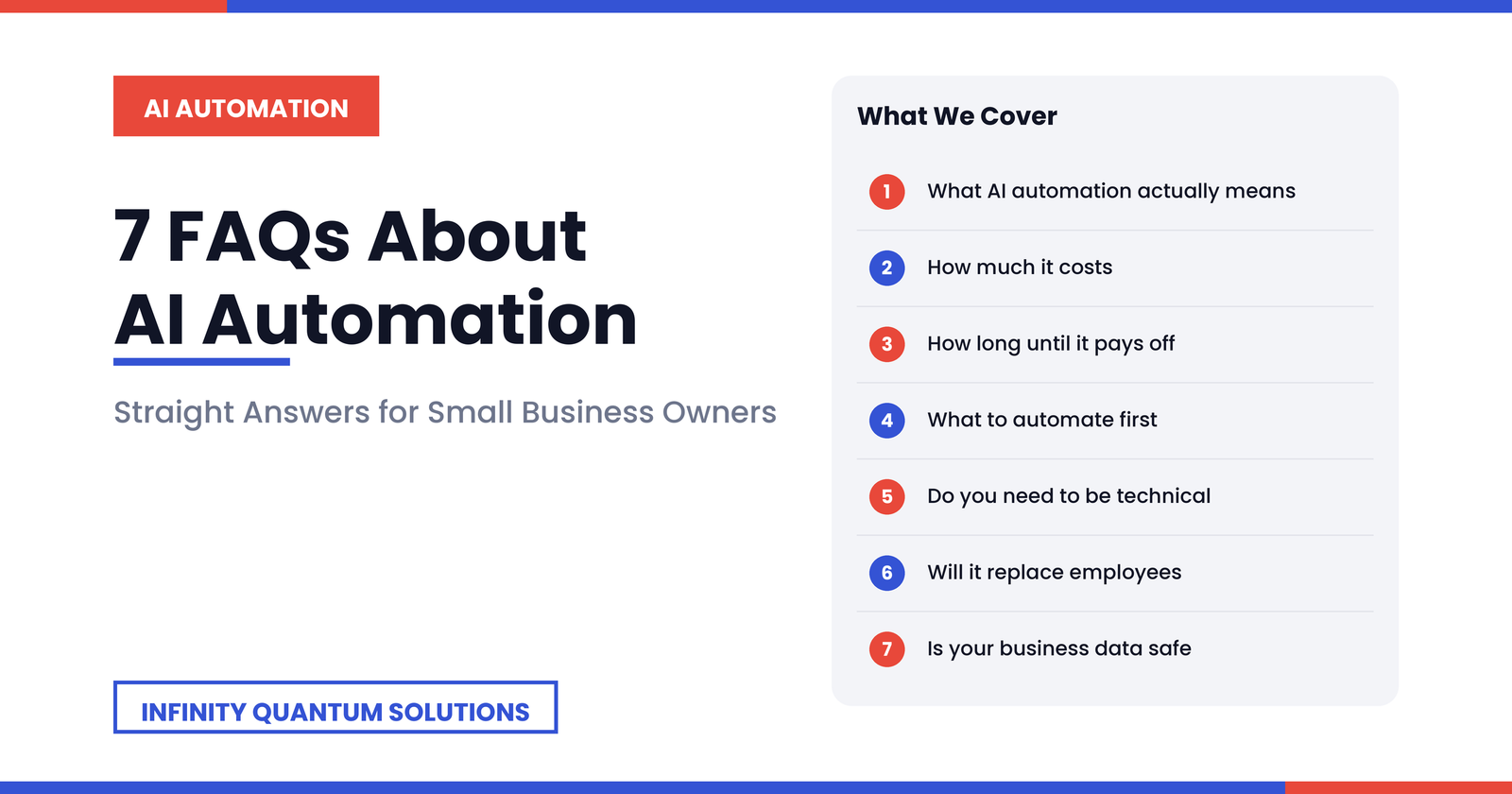
Every small business owner asks some version of the same handful of questions before they automate anything: what does this actually do, what does it cost, will it break something, and is it even worth it for a business my size? Fair questions. Here are straight answers to the seven that come up the most, based on what we actually hear from clients before they sign off on a build. (If you want the bigger-picture case for AI in small business first, we covered that in AI for Small Businesses.)
Quick Answer
- What it means: software that handles a repetitive task for you automatically, invoicing, replies, lead follow-up, without you touching it each time.
- What it costs: anywhere from $50/month for an off-the-shelf tool to $1,000-$150,000+ as a build fee for something custom-built, plus a flat monthly retainer for hosting and support.
- Does it replace staff: usually not, most small businesses use it to free up hours, not cut headcount.
- Is it safe: it depends entirely on how the system is built and what it's connected to, not on AI as a category.
1. What Does "AI Automation" Actually Mean for a Small Business?
Strip away the buzzwords and it's simple: AI automation means a system handles a repetitive task on its own, the way it would if you did it manually every time, without you actually doing it. Sending an invoice. Replying to a common customer question. Following up with a lead the moment they message you. The "AI" part just means the system can handle some judgment or variation in the task (writing a reasonable reply, deciding when a payment is late enough to send a reminder) instead of needing a rigid, if-this-then-that script for every possible case.
It's not a robot running your business. It's a specific, narrow tool doing one or two repetitive jobs so you're not the one doing them at 9pm.
2. How Much Does AI Automation Cost?
It depends entirely on scope, and the range is wider than most owners expect:
| Type | Build Fee | Monthly Retainer | Best For |
|---|---|---|---|
| Off-the-shelf AI tool | - | $50-$500 / user / month | Generic tasks: writing, summarizing, basic support |
| Single custom automation | $1,000-$3,000 | $100+ flat | One specific workflow, like auto-invoicing |
| Multi-system workflow build | $5,000-$15,000 | $250+ flat | Connecting several tools/processes together |
| Full custom platform | $25,000-$150,000+ | $500+ flat | Enterprise-scale, multi-team operations |
Most small businesses don't need the top of that range. A single automation covering one repetitive process, plus its small flat retainer, is usually enough to feel the time savings. Unlike per-seat SaaS pricing, that retainer doesn't climb as your team grows. We go into more depth on when custom actually makes sense versus buying an off-the-shelf tool in AI Software Development Solutions: The Complete 2026 Guide.
3. How Long Until It Pays for Itself?
For a process that's genuinely specific to how your business runs, custom automation typically pays for itself within 18-24 months compared to what you'd otherwise spend on a per-seat SaaS tool or extra hours of manual work. That timeline shrinks fast if the task you're automating was costing you real money to skip, a missed invoice follow-up or a slow lead response, both have a direct dollar cost, not just a time cost.
It's not just a time-saving story either. 91% of small businesses using AI report a revenue increase, not just lower costs, because faster replies and consistent follow-up directly translate into more business closed.
Want a straight answer on your specific payback timeline? At Infinity Quantum Solutions, we'll tell you honestly whether a given automation is worth building for your business before you spend anything. Book a free consultation and we'll walk through the real numbers for your situation.
4. What Should I Automate First?
Whatever's costing you the most time or money right now, not whatever sounds most impressive. In practice, three places tend to pay off first for small businesses:
- Invoicing and payment follow-up - if you're manually chasing late payments, this is usually the fastest win.
- Lead response - the businesses that reply first tend to win the job, and an instant automated first reply beats a same-day human one.
- Repeat customer questions - if you're answering the same three questions daily, that's a clear automation candidate.
Pick one. Get it working well. Then decide if a second one is worth it, rather than trying to automate everything in your business at once.
5. Do I Need to Be Technical to Use It?
No, and that's really the point of having it built for you rather than piecing it together yourself. A well-built system runs in the background, you don't log into a dashboard and configure settings every day. The technical side, connecting your tools, handling edge cases, keeping it running, is the part you're paying someone else to own so you don't have to become the person who maintains it.
6. Will AI Automation Replace My Employees?
For most small businesses, no, and that's not just a reassuring talking point. Research on small businesses using AI found that 9 out of 10 planned to keep or grow their human service teams rather than shrink them. The pattern we see with clients matches that: automation takes the repetitive 20% off someone's plate (the invoice chasing, the repeat questions) so they can spend more time on the parts of the job that actually need a person, sales conversations, relationship building, judgment calls. It's addition by subtraction, not a layoff tool.
7. Is My Business Data Safe?
This is a legitimate concern, not just a hesitation to brush off. Data security is now the single biggest reason small businesses hesitate to adopt AI more deeply, cited by 33% of small business owners as their top barrier, up from 23% just a year earlier. That concern is usually really about one thing: not knowing where your data goes once it's typed into a tool.
The honest answer is that it depends entirely on how the system is built, not on "AI" as a category. A generic consumer AI tool and a custom-built automation connected only to the specific systems you approve are very different risk profiles. When we build something for a client, it's scoped to touch exactly the data it needs to do its one job, nothing gets fed into a public model, and you know exactly what's connected to what. Ask any AI automation provider directly where your data goes and what it's used for, if they can't give you a clear, specific answer, that's worth paying attention to.
Where This Leaves You
Most of these questions come down to the same thing: AI automation isn't one big scary decision, it's a small, specific tool solving a small, specific problem. Start with whatever's actually costing you time or money right now, get a straight answer on cost and payback before committing, and pick a team that can explain exactly what it does and where your data goes.
If you're ready to figure out what that looks like for your business, Infinity Quantum Solutions can walk through it with you, no generic pitch, just a straight answer.