
Written by Usman, founder of Infinity Quantum Solutions, based on 560+ custom applications and automation projects delivered for clients across 35+ countries.
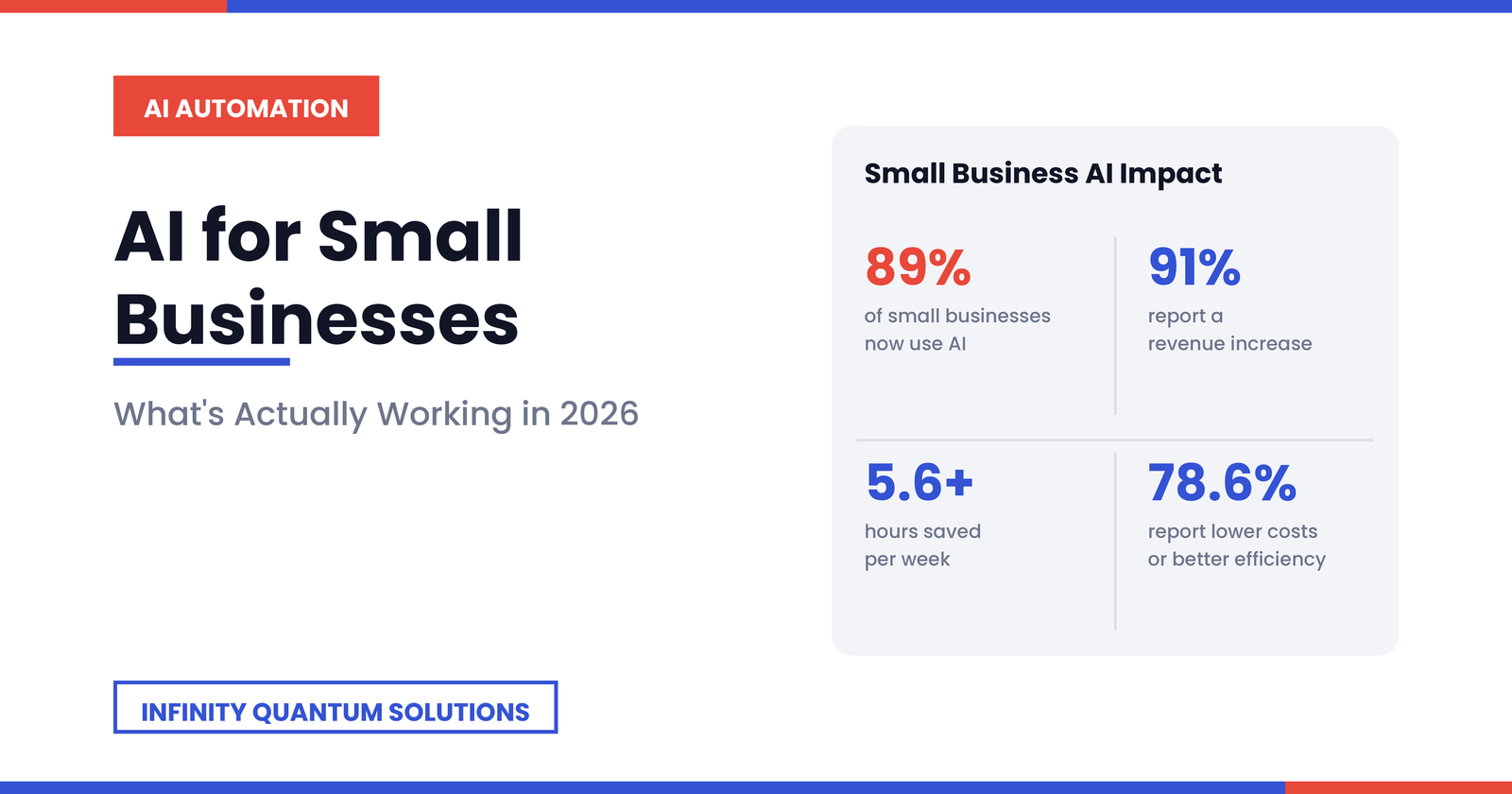
A lot of the "AI for small business" talk online still sounds like it's aimed at big companies with an IT department. It isn't. The businesses actually using AI right now are plumbers, cleaning crews, carpet cleaners, small retailers, the kind of businesses run by one or two people wearing every hat. In 2026, 89% of small businesses are using AI in some form, according to the U.S. Chamber of Commerce's latest Small Business Survey, up from just 36% back in 2023. That's a fast jump for a group of business owners who, three years ago, mostly associated "AI" with chatbots on other people's websites.
So what changed? Mostly, the tools got simpler and the results got obvious. Here's what the data actually shows, how small businesses are using AI day to day, and where it makes sense to bring in help instead of figuring it out solo.
Why AI for Small Businesses Actually Matters Right Now
The stats behind this shift are worth sitting with for a second, because they're not small:
- 91% of small businesses using AI report a revenue increase, and 90% say it made day-to-day operations easier to run.
- 78.6% report lower costs or better efficiency as a direct result of using it.
- The average small business saves 5.6 hours a week. Owners and managers specifically save even more, over 7 hours a week.
- Business owners who've adopted AI are almost twice as likely to report growth year over year than those who haven't.
Seven hours a week doesn't sound like much until you multiply it out. That's close to a full extra workday every week, time that used to go into chasing down invoices, answering the same three customer questions over and over, or following up with a lead two days too late.
How Small Businesses Are Actually Using AI
There's no single "AI for small business" tool. It's really a handful of use cases, each one aimed at a task that eats time without needing much judgment. Right now the most common ones are content and marketing (drafting posts, emails, website copy, the most common use case at 41% of small businesses), customer service (chatbots and automated replies, used by 29%), invoicing and accounting (auto-generated invoices and payment reminders), lead follow-up (instant replies to new inquiries before a competitor gets there), and basic reporting (turning a messy spreadsheet into something readable).
Notice the pattern: every one of these is repetitive. Same steps, every time, regardless of who's doing it. That's usually the tell for whether something is worth automating.
What It Actually Costs You to Skip It
It's tempting to think of "not automating" as just doing things the old way, no harm done. In practice it has a real cost. A missed invoice follow-up doesn't just delay a payment, it can quietly cost a business thousands of dollars a year once you add it up. A lead who messages your business and doesn't hear back for a day often ends up going with whoever answered first. None of that is dramatic on its own. It just adds up, week after week, until it's the reason an owner is working nights instead of the business running itself.
Where We've Seen This Work
We recently built an automation system for Kiingle that now saves their team more than 50 hours a month, time that used to go into manual, repetitive work their staff had to do by hand. That's not an outlier. It's what happens when the repetitive 20% of a business gets handed off to a system built specifically for it, rather than a generic tool bolted on and hoped for the best.
The AI Automations Worth Setting Up First
Not every business needs the same stack, but a few automations tend to pay for themselves the fastest:
- Auto-invoicing and payment follow-up - invoices go out on their own, reminders get sent on schedule, and nobody has to remember to chase a late payment.
- AI customer reply systems - answers the common questions instantly, on your website, Instagram, or Facebook, at 2pm or 2am.
- Automatic lead response - the second someone fills out a form or messages you, they get a real, relevant reply, not a two-day wait.
- Custom workflows - built around how your business actually runs, instead of a generic tool you have to bend your process around.
Want this built for your business instead of piecing it together yourself? At Infinity Quantum Solutions, we build custom AI automation systems for small businesses, invoicing and follow-up, customer replies, lead response, so you get the time back without becoming the person who manages five different tools. Book a free consultation and we'll walk through what it'd look like for your business specifically.
DIY vs. Done-for-You
If you're ready to actually do this, you're choosing between two paths. You can piece it together yourself with off-the-shelf tools, which works fine for one simple task, but gets messy fast once you're trying to connect invoicing, a chatbot, and lead routing into something that actually talks to each other. Or you can have it built for you, matched to how your business already operates, so it works correctly from day one instead of after a few months of trial and error.
Most owners we talk to don't have a spare 10 hours to test five tools and see what sticks. That's really the whole case for going the done-for-you route.
Frequently Asked Questions
Is AI expensive for a small business?
Usually not, at least not compared to the alternative. Most AI automation setups cost far less than hiring another person, and the hours it saves (5-7+ a week, on average) tend to pay for the cost pretty quickly on their own.
What tasks can AI actually automate for my business?
The biggest wins tend to be invoicing and payment follow-up, answering repeat customer questions, replying instantly to new leads, and turning raw data into something you can actually read. If it's the same task every time, it's probably automatable.
How long does setup take?
Depends on how complex it is, but a single automation like auto-invoicing or a customer reply system usually takes weeks, not months, when it's built by a team that's done it before.
Do I need to understand the tech side?
No. That's kind of the point of going done-for-you, you get the benefit without needing to become the person who maintains it.
Where This Leaves You
AI for small businesses stopped being a "someday" thing a while ago. Most of the businesses seeing real gains from it aren't especially technical, they've just automated the repetitive parts first: invoicing, replies, follow-up.
If you're ready to stop doing that part manually, Infinity Quantum Solutions can build it for you, so the time-consuming parts of running your business finally run themselves.