Written by Usman, founder of Infinity Quantum Solutions, based on 560+ custom applications and automation projects delivered for clients across 35+ countries.
Search "AI software development solutions" and you'll get a wall of agencies all claiming to build "cutting-edge AI" without saying much about what that actually means, what it costs, or whether you even need something custom-built in the first place. So let's skip the buzzwords. Here's what's actually happening in AI software development right now, what it typically costs, and how to tell whether your business needs a custom solution or something simpler. (If you're still deciding whether AI makes sense for your business at all, we covered that groundwork in AI for Small Businesses.)
Quick Answer
- AI software development solutions range from off-the-shelf AI tools ($50-$500/user/month) to fully custom-built systems ($1,000-$150,000+ depending on scope).
- Choose off-the-shelf for generic, repeatable tasks (writing, summarizing, basic support).
- Choose custom development when the process is specific to how your business actually operates, it typically pays for itself within 18-24 months at real scale.
- Most small businesses only need one or two focused automations, not a full platform.
Why This Market Moved So Fast
The numbers explain a lot. The global software market hit $823.92 billion in 2025 and is on pace to grow at nearly 12% a year through 2035, with AI-embedded solutions as one of the biggest drivers. On the development side, 85% of developers now use AI tools regularly for coding and debugging, and GitHub's own research found teams using AI coding assistants finish tasks up to 55% faster than teams that don't.
What's more telling is where enterprise software is headed structurally. Gartner expects 40% of enterprise applications to include task-specific AI agents by the end of 2026, up from under 5% just a year earlier. That's not a niche trend anymore, it's becoming the default way software gets built.
Custom AI Development vs. Off-the-Shelf Tools
This is really the core question behind most "AI software development solutions" searches: build something custom, or buy an existing tool? The honest answer is that it depends on what the software actually needs to do for your business.
Off-the-shelf AI tools make sense when you're automating something generic, writing, summarizing, basic customer support, and want to get moving without a big upfront cost. They're fast to deploy and easy to test. The tradeoff shows up over time: per-seat SaaS pricing adds up fast at any real scale, while custom builds are a one-time cost that stays flat as you grow.
Custom AI development costs more upfront but behaves differently over time. Here's how the two approaches typically break down in 2026:
| Approach | Typical Cost | Best For |
|---|---|---|
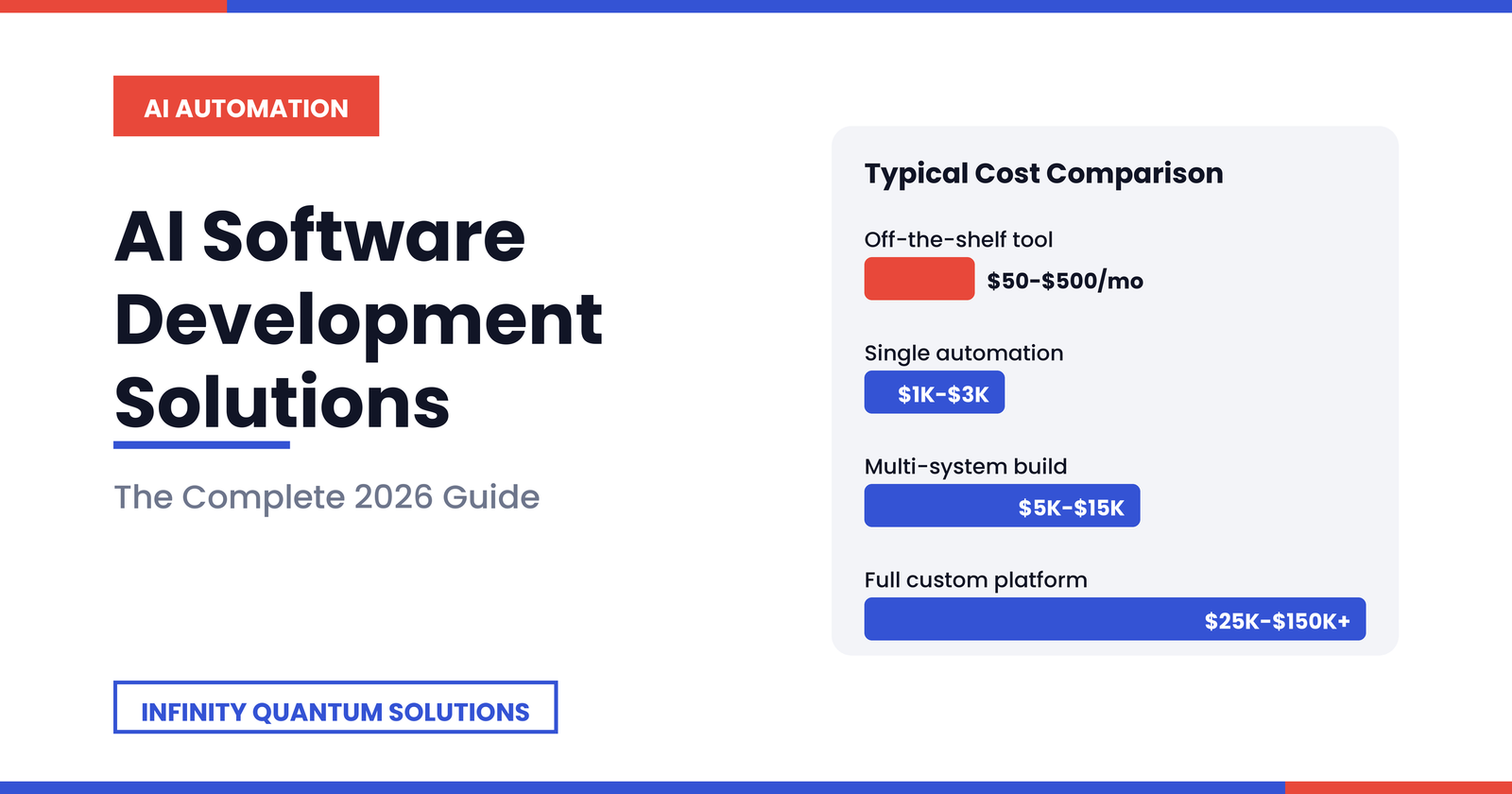
| Off-the-shelf AI tool | $50-$500 / user / month | Generic tasks: writing, summarizing, basic support |
| Single custom automation | $1,000-$3,000 (one-time) | One specific chatbot or workflow |
| Multi-system workflow build | $5,000-$15,000 (one-time) | Connecting several tools/processes together |
| Full custom platform | $25,000-$150,000+ (one-time) | Enterprise-scale, multi-team operations |
For a mid-sized custom build, the two-year cost (build plus roughly 20% annual maintenance) tends to land around $110,000-$210,000, well under what the equivalent per-seat SaaS tool would cost at scale (a $200/user/month tool across 200 employees runs about $480,000 every two years).
The real dividing line isn't really cost, though, it's whether the process you're automating is generic or specific to how your business actually operates. If it's something every business does the same way (drafting emails, summarizing documents), an off-the-shelf tool is usually the smarter first move. If it's the thing that actually makes your business run differently from a competitor, how you route leads, how you price a quote, how you follow up on invoices, that's exactly where custom development earns its cost back.
What a Custom AI Software Solution Actually Involves
"Custom AI software" sounds abstract until you see what it's actually replacing. In practice, most small and mid-sized businesses aren't building some sprawling AI platform, they're automating two or three specific, repetitive processes that currently eat hours of someone's week. Common starting points:
- A single-purpose AI agent - handles one job well, like responding to customer inquiries, generating invoices, or qualifying inbound leads.
- A connected workflow automation - links a few existing tools and processes together (your CRM, your invoicing, your inbox) so information moves without someone manually re-entering it.
- A custom internal tool - built around a process that's genuinely specific to your business, not something a generic SaaS tool was ever designed to handle.
The pattern across all three: they're built around your actual workflow, instead of asking your workflow to bend around a generic tool's limitations.
A Practical Way to Decide
Most businesses don't actually need to pick one approach and commit forever. A reasonable path: start with an off-the-shelf tool to prove a use case is worth solving at all, cheaply and quickly. If it works and the volume is real, that's your signal to replace or extend it with something custom, built around your systems instead of a generic interface. Reserve the ready-made tools for generic, repeatable tasks, and save custom development for the processes that are actually specific to how you operate.
Not sure which side of that line your business falls on? At Infinity Quantum Solutions, we've delivered 560+ automation and custom software projects for clients across 35+ countries, everything from single AI agents to full workflow builds. Book a free consultation and we'll help you figure out what's actually worth building for your business, no generic pitch, just a straight answer.
Frequently Asked Questions
How much does custom AI software development actually cost?
For most small businesses, a single automation (a chatbot or one specific workflow) runs $1,000-$3,000. A multi-system build connecting several processes together runs $5,000-$15,000. Full custom platforms run higher but are typically overkill unless you're operating at enterprise scale.
Is custom AI development worth it for a small business?
It depends on what you're automating. If it's something generic that every business handles the same way, an off-the-shelf tool is usually cheaper and faster. If it's a process specific to how your business actually operates, custom development tends to pay for itself within 18-24 months compared to ongoing per-seat SaaS costs.
What's the difference between an AI tool and custom AI software?
An AI tool (like most SaaS products) is built to work the same way for every customer. Custom AI software is built around your specific workflow, data, and systems, so it fits how you actually operate rather than asking you to adapt to it.
How long does it take to build a custom AI solution?
A single, focused automation can often be built in a matter of weeks. Larger, multi-system builds take longer, but a good rule of thumb is that scope should match your actual need, not the other way around.
How do I choose an AI software development company?
Look for a team that asks about your specific workflow before proposing a solution, not one pitching the same package to every client. Ask to see real delivered projects (not just mockups), confirm who owns the code and data once it's built, and get a clear scope with a fixed cost before committing, vague "let's start and see" pricing is a red flag for scope creep.
Where This Leaves You
"AI software development solutions" isn't really one product, it's a spectrum from quick off-the-shelf tools to fully custom-built systems, and the right answer depends entirely on whether the process you're trying to fix is generic or genuinely specific to your business.
If you're trying to figure out which side of that line you're on, Infinity Quantum Solutions can walk through it with you and build whichever one actually makes sense, not just the one that's easiest to sell.